


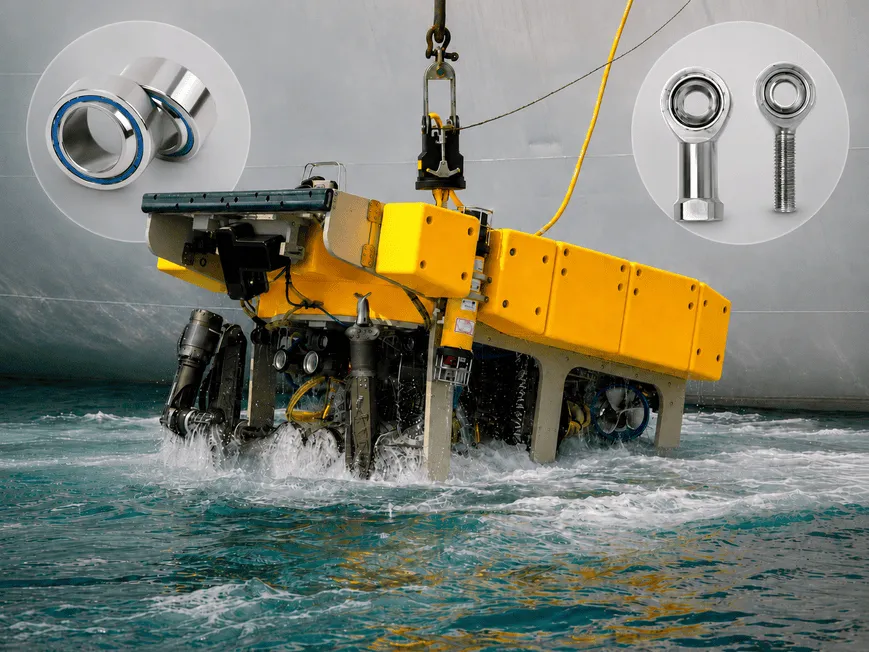
A submerged robot joint carries load, motion and salt
An underwater cleaning or inspection robot may spend only part of each mission below the surface, but its pivot joints can remain wet long after recovery. While the machine climbs a hull, steers, stabilizes a tool or crosses an uneven surface, each joint must carry structural load and articulate without binding. Seawater then remains around the bearing seat, seals and retaining hardware as the robot waits for its next deployment.
This combination makes the bearing position more demanding than a general outdoor linkage. The joint needs corrosion resistance, but it also needs a hard, smooth sliding surface and a liner that can carry repeated oscillating load. Selecting every component in 316 stainless addresses only the first requirement.
For underwater robotics and subsea equipment, a PTFE-lined spherical plain bearing with corrosion-resistant exposed components is usually the most practical starting point. The exact ring materials should then be matched to load, movement and the time seawater remains in the assembly.
A practical spherical plain bearing construction
The bearing works as a material system. Different parts solve different problems:
| Bearing area | Practical starting direction | Purpose |
|---|---|---|
| Outer ring and exposed hardware | 316 or 316L stainless where intermittent seawater contact dominates | Resist chloride attack around the housing and mounting faces |
| Spherical inner ring | Hardened stainless with controlled surface finish | Carry contact pressure and provide a durable counterface for the liner |
| Sliding layer | PTFE fabric or composite liner qualified for the intended wet duty | Support slow oscillation without routine relubrication |
| Pin, retainers and bracket | Compatible corrosion-resistant materials with a free-draining arrangement | Prevent the surrounding joint from becoming the first failure point |
LINOX stainless steel spherical plain bearings include lubricated and PTFE-lined structures, with 316 and hardened stainless material combinations available for application review. A wide-inner-ring or heavy-duty arrangement may also help where the robot joint has limited alignment or a broader mounting span.
Why an all-316 bearing is not automatically better
316 and 316L are useful for exposed marine hardware because molybdenum improves resistance to chloride pitting compared with 304. They are not corrosion-proof in natural seawater, especially inside crevices where water becomes stagnant or salt concentrates during drying. The British Stainless Steel Association summarizes these limits in its guidance on 316 stainless in seawater.
The other limitation is hardness. Austenitic 316 is not normally the first choice for a highly loaded spherical counterface. If the inner ring is too soft or its finish deteriorates, the PTFE liner can wear faster even while the visible parts remain relatively clean.
A mixed stainless construction often gives a better balance: use 316 or 316L where seawater reaches the housing and exposed hardware, then use a hardened stainless inner ring where contact pressure and wear control the design. A 440C or other hardened stainless inner ring needs its own corrosion review because its chloride resistance is not the same as 316. The decision is therefore not “316 or 440C” for the whole bearing; it is which grade fits each function.
For more material context, see the comparison of 316 and 304 stainless bearings in saltwater.
Can a PTFE-lined bearing carry tens of kilonewtons?
Yes, the load range itself does not rule out a PTFE-lined spherical plain bearing. Commercial PTFE-fabric designs are used for high loads at low surface speeds, including marine and subsea positions. The RBC Lubron spherical plain bearing guide shows why the exact liner and ring combination matters: different systems have different static and dynamic pressure limits, water performance and wear characteristics.
The bearing size cannot be selected from “tens of kN” alone. Four values establish whether a standard series is suitable:
- normal and peak load, including any impact;
- radial load versus an axial component or reversing direction;
- articulation angle and cycles per deployment;
- bore, outside diameter and available bearing width.
A slowly oscillating joint with a stable radial load is a strong PTFE-lined candidate. Repeated shock, high-frequency motion or heavy reversing load may require a heavier liner system, a wider bearing or a lubricated steel-on-steel design. The catalog load rating, permitted contact pressure and expected sliding distance must all refer to the same bearing construction.
Would ceramic be better in seawater?
Full ceramic construction is rarely the first choice for a heavily loaded robotic pivot. Ceramic materials can offer excellent corrosion resistance and hardness, but the joint still has to tolerate impact, edge loading, press fits and stress around the pin bore. The surrounding bracket and fasteners also remain metallic unless the complete assembly is redesigned.
Ceramic becomes more relevant as a custom surface solution. A ceramic-coated metal counterface may combine a hard sliding surface with the toughness of a metal inner ring, but coating adhesion and edge loading must be validated for the actual geometry. For most temporarily submerged robots, a well-matched stainless and PTFE system is the lower-risk starting point.
Design the joint to release seawater
Temporary immersion is easier to manage when the joint does not store seawater after recovery. Provide a drainage path around the bearing seat, avoid blind pockets behind washers and retainers, and keep the liner edges protected from direct debris impact. Pins and brackets should use compatible materials so corrosion does not simply move away from the bearing.
After recovery, a freshwater rinse removes salt before evaporation concentrates it inside the joint. Early inspections should track articulation torque, play, staining and liner condition. These observations show whether the next change should be material, sealing, drainage or bearing size.
For a new underwater robot joint, send the normal and peak load, movement angle, deployment cycle and available bearing dimensions through the application inquiry form. LINOX can then compare a PTFE-lined stainless series, a hardened mixed-material design or a custom arrangement against the actual operating position.