


Quick answer
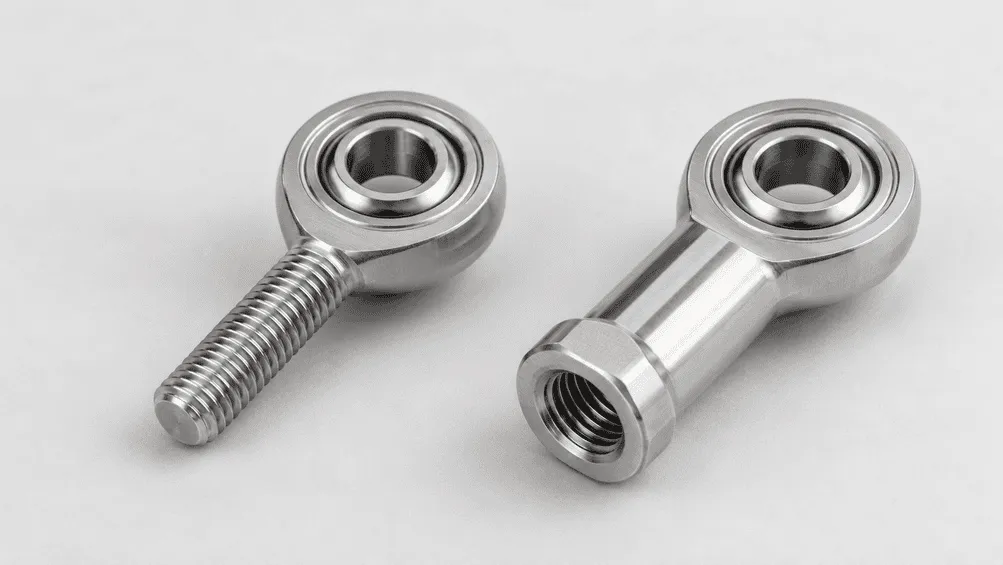
A male rod end has an external threaded shank that screws into a tapped rod, tube, block or mating component. A female rod end has an internally threaded shank that accepts a threaded rod or stud. Both use a spherical bearing to accommodate angular movement, so neither type is automatically stronger or better. The correct choice depends on how the linkage connects, how much installation length is available, where adjustment must occur and whether an existing part must be replaced without changing the assembly.
For stainless steel rod ends, also confirm thread direction, metric or inch standard, housing material, inner ball material and whether the bearing is lubricated or maintenance-free.
Male vs female rod end comparison
The thread connection is the visible difference, but it changes the geometry of the complete linkage.
| Selection point | Male rod end | Female rod end |
|---|---|---|
| Thread form | External thread on the rod end shank | Internal thread inside the rod end shank |
| Mating component | Tapped rod, tube, block or female adapter | Threaded rod, stud or cylinder rod |
| Common series examples | SA, POS and POSB | SI, PHS and PHSB |
| Length adjustment | Rod end turns into the mating female thread | Mating rod or stud turns into the rod end |
| Space consideration | Threaded shank extends from the housing | Thread connection is contained within a larger shank body |
| Replacement priority | Match thread, center-to-end length and shank engagement | Match thread, thread depth, center-to-end length and body clearance |
| Typical mistake | Too little thread engagement in the mating part | Stud bottoms out before the joint reaches its required position |
Male and female versions can often perform the same motion function, but they are not direct substitutes if the linkage geometry and mating thread remain unchanged.
When a male rod end fits the assembly
A male rod end is normally selected when the mating part already has an internal thread. Examples include a tapped linkage tube, an adjustment sleeve, a threaded block or a cylinder accessory with a female connection.
The external shank makes the available thread engagement easy to inspect before assembly. It can also provide a straightforward adjustment method: rotate the rod end to change the center position, then lock the setting with a jam nut where the design requires one.
Check more than the nominal thread size. The usable shank length must provide adequate engagement without colliding with the mating component. The unthreaded shoulder, thread runout and jam nut also occupy space. If the linkage is adjusted close to the end of the thread, the assembly may fit dimensionally while leaving insufficient engagement.
LINOX male metric families include SA configurations, while POS and POSB identify common male linkage arrangements in metric and inch product groups. The exact suffix also indicates the dimensional or sliding-contact family, so the word “male” alone is not a complete part number.
When a female rod end fits the assembly
A female rod end is normally selected when the mating part has an external thread. Common examples include actuator rods, cylinder rods, threaded studs and linkage rods.
Because the thread is inside the shank, the body around it is larger than the matching threaded rod. That body diameter and length need clearance from brackets, guards and nearby moving parts. The mating rod also needs enough usable thread to reach the required position without bottoming out inside the rod end.
Female rod ends are useful when the assembly is already built around a threaded rod. Adjustment can be made by rotating the rod end, the rod or an intermediate adjuster, depending on whether the linkage can be disconnected and whether the opposite end uses right-hand or left-hand thread.
LINOX female metric families include SI configurations, while PHS and PHSB identify common female metric and inch linkage arrangements. As with male types, confirm the complete series and dimensions rather than ordering from the thread style alone.
How mounting space changes the choice
The shortest-looking component is not always the shortest assembled solution. Compare the center of the spherical bore to the end of the complete connection after the required thread engagement is included.
A male rod end may have a slim external shank, but it still needs a mating sleeve or tapped component. A female rod end contains the threaded connection in its body, but the body may be wider and may require a longer threaded rod. In a fixed-length replacement, changing from male to female usually requires redesigning the adjacent connection rather than changing only the bearing.
Review these dimensions together:
- spherical bore and mating pin diameter;
- center-to-end or overall length;
- housing and ball width;
- male shank length or female thread depth;
- thread size, pitch and tolerance;
- jam nut thickness and adjustment range;
- body clearance through the full articulation angle.
For existing equipment, a measured sample or drawing is more reliable than selecting from a photograph. Perspective can hide the thread type, and a jam nut can make a male connection look like a separate stud.
Right-hand and left-hand threads
Male versus female describes where the thread is located. It does not describe thread direction. Either type may use a right-hand or left-hand thread.
Using one right-hand and one left-hand rod end on the same linkage allows length adjustment by rotating the connecting tube or turnbuckle without disconnecting either end. This arrangement is common in steering links, control rods and positioning assemblies. It also creates an ordering risk because two parts can look identical while using opposite thread directions.
Mark left-hand parts clearly and pair them with the correct jam nuts and mating threads. For replacement work, verify direction by testing the known mating part or reading the drawing; do not infer it from the installation side.
Metric and inch series
Thread style and dimensional standard are separate decisions. A rod end can be male or female in either metric or inch form.
| Dimensional family | Male examples | Female examples | Typical selection context |
|---|---|---|---|
| Metric SA / SI | SA | SI | Industrial machinery, automation and ISO-style drawings |
| Metric linkage series | POS | PHS | Standard metric linkage and replacement assemblies |
| Inch linkage series | POSB | PHSB | North American equipment, legacy designs and imperial replacements |
Do not convert an inch thread to the nearest metric size, or vice versa. Similar diameters can have different pitches and thread forms. A part may start to assemble and then damage both threads. Compare the designation, actual pitch, bore, widths and center height against the stainless steel rod ends product data.
Material and bearing structure are separate choices
Choosing male or female does not determine the stainless grade or internal bearing structure. Both connection styles can be reviewed with corrosion-resistant housings and different spherical contact arrangements.
For general humidity and moderate cleaning, a 304 stainless housing may be considered. Repeated washdown, chloride exposure and marine service often move the discussion toward 316 stainless for exposed housing and hardware. A hardened stainless inner ball may be used where contact wear matters. The final combination should account for the pin, jam nut, washer and mating rod as well as the rod end itself.
The internal structure also matters:
- PTFE-lined maintenance-free rod ends reduce routine greasing where access is limited or a cleaner assembly is preferred.
- Steel-on-steel lubricated rod ends suit applications where relubrication is planned and load or impact conditions favor that structure.
- Bronze-lined or custom combinations may be reviewed for particular dimensional, friction or replacement requirements.
If the assembly operates in salt spray, compare 304 and 316 stainless bearing materials. For stainless threaded assemblies, account for rod end thread galling before setting the production assembly method.
Can male and female rod ends be interchanged?
They can perform the same spherical articulation function, but they normally cannot be exchanged without changing the mating connection. Replacing a male rod end with a female one requires a threaded stud or rod where the original assembly had an internal thread. Replacing a female rod end with a male one requires a tapped component or adapter.
An adapter can make the threads connect, but it also changes length, stiffness, clearance and the number of joints that can loosen. In safety-critical, high-load or fast-cycling linkages, treat that as a design change rather than a catalog substitution.
For a direct replacement, keep the original connection style unless the complete linkage has been reviewed. Match the center position, thread engagement, bore, ball width, articulation angle, load rating and stainless material requirement.
Practical selection examples
For a pneumatic or hydraulic cylinder with an externally threaded rod, a female stainless steel rod end is usually the natural connection. Check the rod thread, available body clearance and whether the rod can rotate during adjustment.
For an adjustment tube with tapped ends, male rod ends are normally used. A right-hand thread at one end and a left-hand thread at the other can provide in-place length adjustment.
For a corroded marine steering link, preserve the original male or female connection unless the steering geometry is being redesigned. Confirm the thread direction, center length and pin fit, then review stainless materials and maintenance structure using the marine steering rod end guide.
For a washdown machine, connection style follows the mechanical layout, while stainless grade, thread accessibility and cleanability follow the environment. Avoid pockets around female threads and jam nuts where cleaning liquid can remain trapped.
What identifies the correct rod end
Start with the mating connection, but finish with the complete specification. A useful replacement or quotation record includes the rod end series or old part number, male or female thread, thread size and pitch, right-hand or left-hand direction, bore, housing and ball widths, center-to-end length, material, liner or lubrication style, load and operating environment.
When the original designation is unknown, send a dimensioned sketch or sample measurements rather than relying on the general description “male rod end” or “female rod end.” That separates a connection choice from a verified replacement.
Reference notes
- ISO, ISO 12240-4:1998, for spherical plain bearing rod end dimensions and tolerances.
- SKF, Rod ends, for general rod end terminology and selection context.