


Quick answer
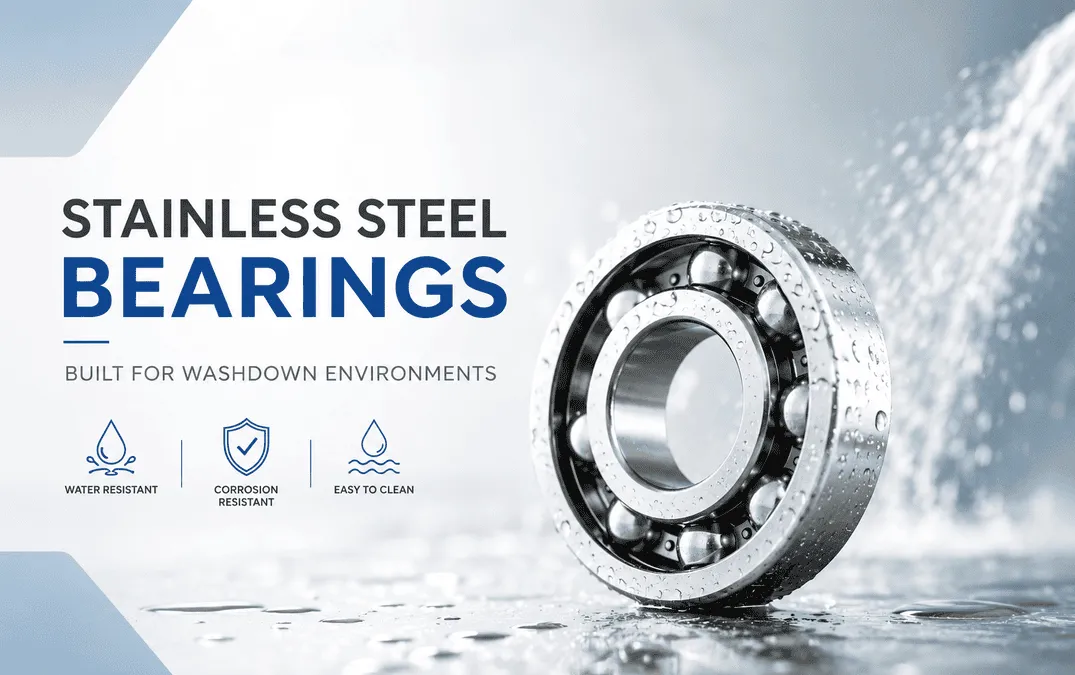
For washdown environments, start by reviewing stainless steel bearing materials, cleanable mounting geometry, seal and lubricant compatibility, and whether water or cleaner can remain trapped after rinsing. 316 stainless steel is often the safer starting point for repeated cleaning, chloride cleaners, wet food equipment and exposed hardware, but the final choice depends on exposure severity, load, movement and maintenance access.
The key question is not simply “Is the bearing stainless?” It is whether the complete bearing assembly can survive repeated spray, detergent, sanitizer, temperature change and drying cycles without corrosion, lubricant washout, hidden contamination or premature wear.
Why washdown is different from ordinary wet service
A washdown bearing is exposed to more than clean water. In food processing, packaging, beverage, pharmaceutical and clean industrial equipment, the bearing may see high-pressure spray, foam cleaner, sanitizer, warm water, caustic chemicals, chlorides or long periods of humidity after cleaning.
That combination creates several failure paths:
- water can wash lubricant out of the contact area;
- cleaner can attack seals, liners or grease;
- chloride residue can dry around threads, washers and bearing shoulders;
- trapped liquid can cause crevice corrosion;
- adjacent carbon steel hardware can stain a stainless bearing assembly;
- high-pressure spray can push contamination past weak seals.
Food equipment rules also push the design toward cleanable, corrosion-resistant and non-contaminating surfaces. The U.S. current good manufacturing practice rule for food equipment says equipment must be designed and built so it can be adequately cleaned and maintained, and food-contact surfaces must be corrosion-resistant when in contact with food. That does not automatically specify one bearing grade, but it explains why material, drainage and cleanability matter in the bearing area.
304 vs 316 stainless steel in washdown
304 stainless can work in mild water contact, indoor humidity and light cleaning. It is common, economical and corrosion resistant in many general environments. The risk increases when cleaning is frequent, chloride-based, warm, stagnant or difficult to rinse.
316 stainless adds molybdenum, which improves resistance to chloride-related pitting compared with 304. For repeated washdown, salt-containing food residue, coastal plants, meat or seafood processing, dairy lines, bottle filling, and equipment cleaned with stronger chemicals, 316 is usually the first material to review for exposed housings, studs, nuts and washers.
| Washdown condition | Main risk | Practical starting point |
|---|---|---|
| Occasional clean water rinse | light staining, lubricant loss | 304 or 316 depending on duty and appearance requirement |
| Daily food plant washdown | trapped moisture, cleaner residue | 316 often reviewed first for exposed parts |
| Chloride sanitizer or salt-containing product | pitting and crevice corrosion | 316 / 316L discussion, plus drainage review |
| High-pressure spray | seal bypass, lubricant washout | sealed or protected bearing design, not material alone |
| Caustic or acidic cleaning | material and seal compatibility | check cleaner chemistry before approving material |
| Hidden pockets around threads or brackets | stagnant liquid and corrosion | reduce crevices and specify compatible hardware |
316 is not magic. If cleaner remains trapped under a washer or inside a thread pocket, even a better alloy can stain or pit over time. The bearing selection should be paired with cleanable mounting design.
Seal, lubricant and liner choices
The metal grade is only part of a washdown bearing decision. A bearing can use stainless components and still fail because the grease washes out, the seal material is not compatible with the cleaning chemical, or the liner is exposed to repeated moisture and abrasive residue.
For rolling bearings and cam followers, check whether the rolling contact is directly exposed to spray or shielded by machine guarding. A stainless stud or housing may resist corrosion while the internal rolling elements, seal lips or lubricant become the weak point.
For rod ends and spherical plain bearings, check whether the ball and liner are exposed directly to cleaning fluid. Slow articulation, edge loading and misalignment can remove protective films faster than a simple static exposure test suggests.
Useful questions include:
- Is the bearing directly sprayed or only exposed to humidity?
- Is the spray low-pressure rinse, hose washdown or high-pressure cleaning?
- What cleaner or sanitizer is used, and at what concentration?
- Does the bearing need grease, a dry-running liner or periodic relubrication?
- Can water drain away after cleaning?
- Are the shaft, pin, nut, washer and bracket also stainless or compatible?
Cleanability around the bearing matters
In washdown equipment, the bearing location often fails before the bearing material does. A shoulder, mounting slot, threaded rod end, spacer, washer stack or cam follower stud can create a narrow crevice where water and cleaner remain after the line is shut down.
A cleanable design should avoid liquid traps where practical. Use compatible fasteners, avoid unnecessary overlap, allow rinse water to drain, and make inspection possible. If a part is buried inside a bracket and only cleaned from one direction, the hidden side may stay wet much longer than the visible side.
NSF food equipment material guidance emphasizes materials that are cleanable and resist corrosion in their intended use. For bearing areas, that usually means the material choice and the surrounding design need to be reviewed together instead of treating the bearing as an isolated catalog item.
When to use stainless rod ends, spherical plain bearings or cam followers
Different bearing types fail differently in washdown service.
- Use stainless rod ends when the assembly needs threaded linkage adjustment, angular movement and compact mounting. Review the thread area, jam nut and exposed ball.
- Use stainless spherical plain bearings when the joint needs higher misalignment capacity or a bearing pressed into a housing. Review liner exposure and drainage.
- Use stainless cam followers when the roller follows a track, rail, cam or guide path. Review seal structure, rolling contact, stud material and whether the track itself retains cleaner.
For washdown equipment, the best option is usually the one that leaves fewer hidden liquid traps while still meeting load, alignment and wear requirements.
Common specification mistakes
A washdown bearing inquiry often goes wrong when the request only lists dimensions and material. The same size bearing may need different construction in a bakery conveyor, seafood line, bottling machine, pharmaceutical packaging machine or outdoor cleaning station.
Common mistakes include:
- specifying “stainless” without saying whether 304, 316 or another grade is required;
- choosing 316 for the bearing but using plated nuts or carbon steel brackets;
- ignoring the cleaning chemical and only describing the product being processed;
- assuming a sealed bearing is automatically suitable for high-pressure spray;
- placing the bearing where rinse water cannot drain;
- using a chrome steel replacement because the original part number fits.
The safest review separates corrosion resistance, washout resistance, cleanability and mechanical load instead of using one material label as the whole specification.
Information to send for a quote
Before requesting a quote, collect enough application detail to make the material discussion useful.
- Bearing type: rod end, spherical plain bearing, cam follower, ball joint or custom component.
- Size and drawing: bore, thread, width, mounting style and tolerance requirement.
- Material expectation: 304, 316, 316L, 440C, mixed material or open to review.
- Cleaning method: rinse, foam, hose, high-pressure spray or CIP nearby.
- Cleaner details: chemical name, concentration, temperature and contact time.
- Operating condition: load, speed, oscillation angle, duty cycle and alignment.
- Hardware set: shaft, pin, washer, nut, bracket and mating material.
- Maintenance plan: relubrication, inspection interval and replacement access.
If a current bearing is failing, photos are useful. Pitting at the edges may suggest crevice retention. Rust-colored staining may come from nearby non-stainless hardware. Damage on the contact surface may point to overload or lubricant loss rather than pure corrosion.
External references
- eCFR, 21 CFR 117.40 Equipment and utensils, for food equipment cleanability and corrosion-resistant surface requirements.
- NSF, Food Equipment Materials, for material and cleanability principles in food equipment.
- Schaeffler, Corrosion-resistant products, for corrosion-resistant bearing product context.
- Timken, IP69K waterproof bearing housed unit, for high-pressure washdown bearing unit context.
Final selection rule
Choose bearings for washdown environments by exposure first, not by catalog size alone. Confirm the cleaning chemistry, spray pressure, drainage, bearing type, stainless grade, lubricant or liner, and surrounding hardware. If the equipment is washed frequently or uses chloride cleaners, start the discussion around 316 stainless components and then refine the design around load, wear and cleanability.